
Custom Software vs. Off-the-Shelf Software: Which Is Right for Your Business?
The right choice depends on process fit, total ownership cost, data control, and the direction of your business—not on a blanket rule.


The real difference is process fit
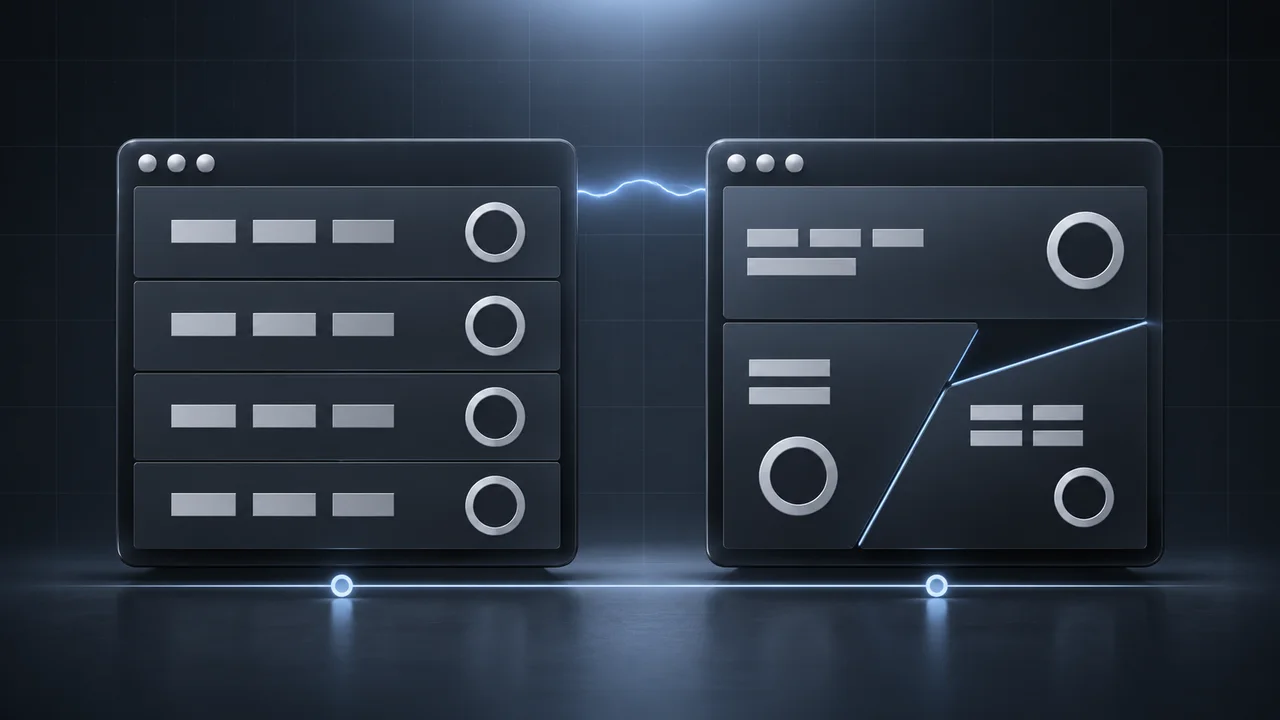
Off-the-shelf software is built for a broad market and aims to solve a common problem for many customers. Custom software is designed around the workflows, rules, and constraints of a particular organization. This does not make one inherently better. The question is how much of your important work the available product supports without costly workarounds.
If a ready-made product covers the requirements well, custom development may add needless complexity. If teams repeatedly reshape essential processes to fit the tool, a tailored solution may deserve evaluation.
Compare the options across the full decision
Capability and workflow fit
A packaged product usually offers predefined workflows, settings, and extensions. That can be an advantage: fewer decisions and a faster path to adoption. Custom development can model specific roles, approvals, calculations, and process stages, but each additional capability carries design, implementation, and testing effort.
Initial spend and total cost of ownership
A subscription or license may look predictable, but evaluate user tiers, paid extensions, customization, data migration, and the cost of leaving the service. Custom software often requires a larger initial investment. Its ongoing cost depends on architecture quality, documentation, infrastructure, and the support arrangement.
Compare a defined ownership period rather than one invoice: setup, subscriptions, extensions, training, operations, support, and vendor-dependency risks.
Ownership, data, and dependency
With packaged software, the vendor generally controls the product and its infrastructure; your rights depend on the contract and available export features. For a custom project, specify ownership and access for source code, data, domain, hosting, documentation, and third-party accounts. The word “custom” alone does not establish intellectual-property ownership. The agreement does.
Extensibility and integration
Standard integrations may be readily available in a mature product. Complex two-way data exchange or unusual business rules can expose platform limits. Custom development offers more control but also makes the project responsible for maintaining integrations as external APIs change.
When off-the-shelf software is a sensible choice
- Your problem is common and your workflows are close to standard patterns.
- Security, permissions, and reporting meet your actual requirements.
- Required extensions are credible and maintainable.
- Data export and future migration are clearly supported.
- Time to adoption matters more than owning a differentiated workflow.
When to evaluate custom development
- Essential business processes do not fit existing products.
- Multiple systems must exchange data under specific rules.
- You need specialized roles, permissions, or approval paths.
- Your operational data or logic is strategically important.
- Repeated workarounds or platform limits have become material.
These conditions do not mean every component must be built from scratch. A packaged core combined with a small custom module can be a more balanced architecture.
A practical decision framework
- Describe the business outcome without naming a technology.
- Map the current workflow and its points of friction.
- Separate essential requirements from preferences.
- Test two or three packaged options against real scenarios.
- Compare ownership cost, data export, security, support, and API limits.
- Estimate a custom or hybrid option only if critical gaps remain.
Use an MVP to reduce uncertainty
A minimum viable product is not a careless or unfinished product. It is the smallest coherent set of capabilities that tests the core business assumption in real use. Before building a complex operations platform, for example, a team might validate its main workflow with a limited number of roles and reports. Further investment should follow observed usage and confirmed needs.
The hybrid option is often overlooked
The decision is not always between buying everything and building everything. A packaged accounting or customer-management product may work well while a distinctive workflow needs a small operations console or integration layer. Keeping mature systems and building only the missing part can balance cost and delivery risk.
For a hybrid design, define data ownership clearly: which system is the source of truth for each record? Which system commits a change? What happens when an integration is unavailable? Who resolves conflicting updates? An integration without an owner for failures merely moves complexity behind the interface.
Run a small evaluation before committing
Prepare three realistic scenarios rather than judging a product from a sales demonstration: the normal path, an exception, and a likely future change. Test a packaged option with representative data and record manual effort, reporting gaps, and output quality. For a custom option, evaluate a narrow slice of the main workflow instead of accepting a promise to build every feature before discovery.
At the end, list the assumptions that remain guesses. Validate them through a trial, contract review, or technical assessment before making a large commitment.
Conclusion
Choose packaged software when it covers important needs at an acceptable cost and with manageable constraints. Consider custom development when process fit, integration, or control cannot be achieved with available options—and when the business value justifies the investment.
Explore Uzap's web application and software development service. If the requirements are still unclear, technical consulting can help define the problem before a build decision is made.